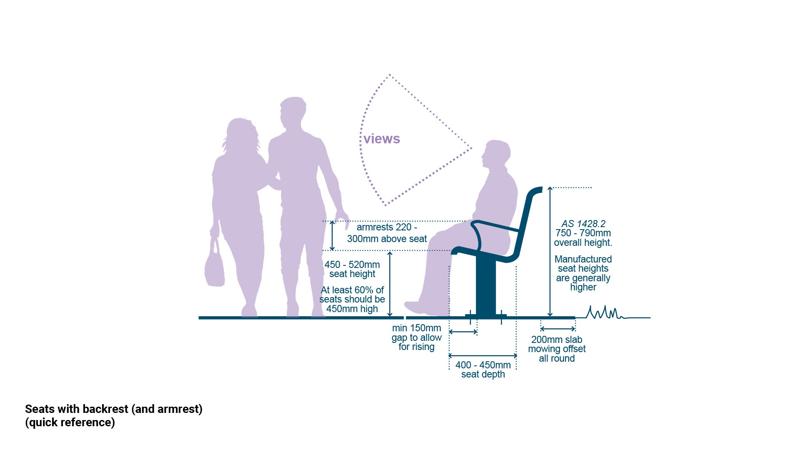
Locate in parks/open spaces/natural areas where rest and relaxation may be desirable. Face the seat towards views where possible
Should be on a concrete slab and linked to a pathway (where possible)
Comply with Austroads 500 mm minimum offset to any obstacle beside a path
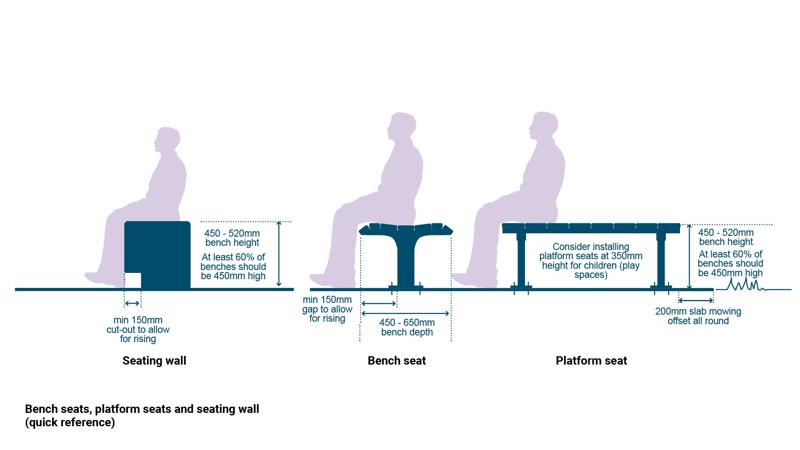
Where feasible, a range of seat heights should be provided
Locate seats under shade where possible
Include a space (on one side of seat) for a wheelchair/pram
Do not install seats where they may be used for climbing over a fence/wall (such as at fenced play spaces or dog off leash parks). Provide 2.0 m clearance
Install seats at 60 m intervals along a linear path (recommended).
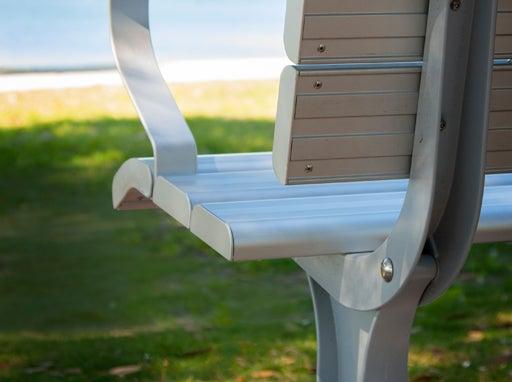
Materials preferred – aluminium or timber. Select light coloured aluminium to reduce the potential for the seat to become hot in full sun. Minimum 3 coats of timber sealant. Material selection should be determined by site profile/level of use.
Excavation for footings under trees should be made by hand or vacuum excavation
All seats must be bolt down and use anti-vandal ‘armour rings’ or equivalent
Avoid finished height difference between a seat concrete slab and adjoining surfaces to prevent trip hazards and to prevent ‘tramlining’ of wheelchair wheels. Batter down gently from the slab to existing ground level.
Note: Further guidance and clarification of the content on this page, can be found in the relevant sections of this information sheet.
Locate in parks/open spaces/natural areas where rest and relaxation may be desirable. Face the seat towards views where possible
Should be on a concrete slab and linked to a pathway (where possible)
Comply with Austroads 500 mm minimum offset to any obstacle beside a path. Extra space is required for leg room.
Where feasible, a range of seat heights should be provided
Locate seats under shade where possible
Include a space (on one side of seat) for a wheelchair/pram
Do not install seats where they may be used for climbing over a fence/wall (such as at fenced play spaces or dog off leash parks). Provide 2.0 m clearance
Materials preferred – aluminium or timber. Select light coloured aluminium to reduce the potential for the seat to become hot in full sun. Minimum 3 coats of timber sealant. Material selection should be determined by site profile/level of use.
Excavation for footings under trees should be made by hand or vacuum excavation
All seats must be bolt down and use anti-vandal ‘armour rings’ or equivalent
Avoid finished height difference between a seat concrete slab and adjoining surfaces to prevent trip hazards and to prevent ‘tramlining’ of wheelchair wheels. Batter down gently from the slab to existing ground level.
Sandstone (or other material) seating walls must have a 150 mm gap to allow for rising.
Note: Further guidance and clarification of the content on this page, can be found in the relevant sections of this information sheet.
Page payload data
This component is currently in development
Sunshine Coast Open Space Landscape Infrastructure Manual (LIM) DISCLAIMER
Disclaimer
Information contained in this document may change without notice and you should use the current material available from Council’s website and not rely on material previously printed or stored by you.
All figures and diagrams are intended to be used as an aid to design and include Council’s preferred elements but they are not intended to be prescriptive and may need to be varied as dictated by site specific factors. While Council has exercised reasonable care in preparing this document, it does not warrant or represent that it is accurate or complete. The Council will not accept responsibility for any loss, damage, cost or expense that you may incur as a result of the use of or reliance upon any material contained in this document.
This document is produced to convey general information and is not intended to constitute advice whether professional or legal. Any reference to legislation in this document is not an interpretation of the law. It is to be used as a guide only. Consult relevant authority websites for current documents, revisions and amendments.
Where a particular product or supplier is profiled in this document, Council is NOT nominating this product or supplier as the selected choice. Product/supplier information has been provided to allow users to source products which contain the correct elements required for Council embellishments. Each product profiled states ‘or equivalent’ which means that different products may be supplied provided they satisfy the identified performance criteria, recommended standards, equal access guidance and product specifications.
Product design, manufacture and installation requires appropriately qualified people to provide site specific solutions to ensure the embellishment is appropriately adapted to local conditions and data.
This document does not override requirements stipulated in a development approval. Project specific variations may be appropriate as a result of site, environmental or other constraints. Any variations to these standards must be approved in writing by council prior to commencement of variation works. Components of this document may be used within a contract document but users should undertake their own investigations to confirm the information is suitable for this purpose.
Drawings contained in this document are NOT FOR CONSTRUCTION.
Details in this document are deemed to be the minimum standard and the user may wish to apply a higher standard subject to approval by council.
Acknowledgements
Council wishes to thank all contributors and stakeholders involved in the development of this document.
Copyright
Sunshine Coast Regional Council (Council) supports and encourages the distribution of its material however, copyright protects this document. Council has no objection to this material being reproduced but only if council is recognised as the owner of the copyright and this material remains unaltered.