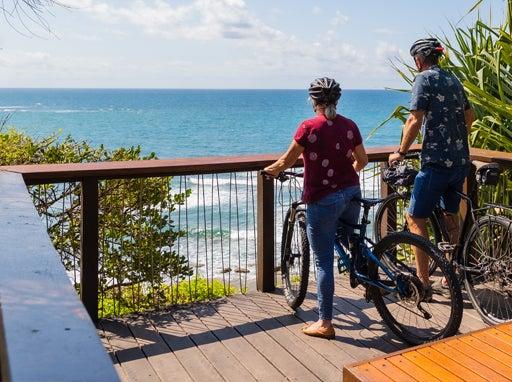
Boardwalks and viewing platforms
Standards
Compliance requirements for embellishments
Note:
- Where Australian Standards or part thereof have been adopted by legislation, they are a legal requirement.
- This list may not be exhaustive. Please refer to the relevant authority websites for updated information and current document distribution dates. These documents are subject to amendments from time to time.
Legislation
Refer Legislation for guidance.
Australian Standards/industry guidelines
National Construction Code (NCC)
The embellishment shall be developed in accordance with the NCC (current edition):
- Building Code of Australia (BCA) Volumes 1 and 2
- Plumbing Code of Australia (PCA) Volume 3.
Safety in design (SiD)
Include Safety in Design (SiD) principles to eliminate, or if not reasonably practical, minimise risks to health and safety throughout the design, construction and life of the embellishment.
See Legislation – Work Health and Safety Act 2011 for additional safety guidance.
Boardwalks and viewing platforms
Design
- Austroads Guide to Road design Part 6A: Paths for walking and cycling. Guidelines for the geometric design of paths for pedestrians & cyclists, includes safety offsets.
- Austroads Guide to Bridge Technology
- AS 1657:2013 – Fixed platforms, walkways, stairways and ladders – Design, construction and installation. Design of fixed platforms, walkways, stairways for inspection, maintenance and servicing personnel.
- AS 5100:2017 Series Bridge Design. Requirements for new bridges and other structures.
- Design Criteria for Bridges and Other Structures Feb 2021 - Department of Transport and Main Roads. Requirements for the design of bridges and other road related structures
- AS 1170.Set 2007 Structural design actions –(Loading Code).
- Design Criteria for Floating Walkways and Pontoons: October 2015 – Department of Transport and Main Roads. Design for modular floating walkways that are to be constructed on boat ramps lanes and standalone pontoons with gangways.
- AS 4997:2005 – Guidelines for the design of maritime structures. Design of structures in a marine environment.
- Outdoor Structures Australia: Boardwalk Design Guide. Free guideline for the construction of timber boardwalks and a range of timber advisory notes.
Footings
- AS 3600:2009 – Concrete structures. Minimum requirements for plain concrete pedestals and footings.
Barrier
- AS 1170.1:2002 Part 1 Structural design actions, Section 3.6 Barriers. Includes parapets, balustrades and railings, together with members and connections that provide structural support.
- AS 2156 (Set):
- AS 2156.1: 2001 – Walking tracks – Part 1 – Classification and signage. A classification system for walking tracks to inform AS 2156.2.
- AS 2156.2-2001 – Walking tracks – Part 2 – Infrastructure design. Requirements for the structural design of walking track structures.
See LIM Handrails and Balustrades for further guidance
Surfaces
- AS 3661.2:1994 – Slip resistance of pedestrian surfaces – Guide to the reduction of slip hazards. Guidance on the selection, installation, care and maintenance of surfaces in public areas for the purpose of reducing the slip hazard to pedestrians.
- AS 4586:2013 – Slip resistance classification of new pedestrian surface materials. Provides means of classifying pedestrian surface materials according to their frictional characteristics when determined in accordance with the test methods set out in Appendices A, B, C, D and E. The test methods enable characteristics of surface materials to be determined in either wet or dry conditions.
- This Standard is referenced in legislation.
- AS 4663:2013 – Slip resistance measurement of existing pedestrian surfaces. Provides methods of measuring the frictional characteristics of existing pedestrian surfaces in wet and dry conditions.
- HB 197:1999 – Standards Australia Handbook - An introductory guide to the slip resistance of pedestrian surface materials. Provides guidelines for the selection of slip-resistant pedestrian surfaces classified in accordance with AS/NZS 4586.
- SA HB 198:2014 – Standards Australia Handbook - Guide to the specification and testing of slip resistance of pedestrian surfaces. Provides guidance for designers, specifiers, manufacturers and suppliers in the application of AS 4586:2013 and AS 4663:2013.
Coatings
- ISO 12944-1:2017 Paints and varnishes - Corrosion protection of steel structures by protective paint systems. A general statement on health, safety and environmental protection, and guidelines for using ISO 12944 (all parts) for a given project.
Designing for shade
- Creating Shade at Public Facilities: Policy and Guidelines for Local Government Edition 2 - prepared by Australian Institute of Environmental Health. Technical resource containing guidelines about ‘essential’ and ‘preferred’ quantities of shade at public facilities.
Designing for access and inclusion
- AS 1428 (Set) – Design for access and mobility. Design requirements for new building work to provide access for people with disabilities. This Standard is referenced in legislation.
Designing for safety (CPTED)
- Queensland Government – Crime Prevention Through Environmental Design (CPTED) – Guidelines for Queensland, 2021. Provides guidelines about designing a safe environment to assist in the prevention of the opportunity for crime.
Erosion and sediment control
- Best Practice Erosion and Sediment Control (BPESC) documents - IECA Australasia. Erosion and sediment control documents by the International Erosion Control Association (IECA).
- Queensland Acid Sulfate Soil Technical Manual: Soil Management Guidelines. Technical and procedural advice to avoid environmental harm and to assist in achieving best practice environmental management (BPEM).
- Procedural guide (Environmental Protection Act 1994) - Releases to waters. Best practice guide to achieve water quality objectives and management goals:
- from building sites and small construction sites less than 2500 m2
- from land development sites and construction sites greater than 2500 m2.
Trees
- AS 4970:2025 – Protection of trees on development sites. Provides guidance on the principles for protecting trees on land subject to development.
- AS 2303:2018 – Tree stock for landscape use. Specifies the criteria for the assessment of above-ground and below-ground characteristics of tree stock that are to be supplied for landscape use.
- AS 4373:2007 – Pruning of amenity trees. Specifies methods for pruning trees and gives guidance on correct and uniform practices.
Approvals/authorised person
Assessable development
Where the embellishment is ‘assessable development’ it requires building approval from a private building certifier and must meet all of the requirements of the Building Regulation 2006, the Building Code of Australia (current edition) and the Sunshine Coast Planning Scheme 2014.
QBCC licensed builder
In Queensland, individuals and companies must hold a Queensland Building and Construction Commission (QBCC) license to carry out:
- Any building work valued over the QBCC amount (includes all labour and materials costs regardless of who supplies the materials).
Certification
- In addition to the standard information listed above, at practical completion, the contractor must supply technical specifications for structure and including, but not limited to:
- Structural certification by a registered professional engineer of Queensland (RPEQ) is required for all boardwalks and viewing platforms.
- All inspections, final approvals and documentation must be certified by a suitably qualified engineer detailing:
- That the design, construction and installation of the structure has been undertaken to the manufacturers specifications in compliance with:
- Australian Standards
- All other relevant statutory requirements codes, regulations and standards.
- That the design, construction and installation of the structure has been undertaken to the manufacturers specifications in compliance with:
- Building certification is required for all boardwalks and viewing platforms. The contractor installing the structure is to organise a private certifier as part of the contract, site specific due to differing topography and shielding class.
Coastal management district
- Ensure appropriate environmental approvals are obtained and the conditions observed where any building work is proposed in the Coastal Management District.
- Consult with Queensland Government Department of State Development, Infrastructure and Planning (DSDIP) – State Assessment and Referral Agency (SARA) for application forms, guidelines and information sheets.
Other
- Ensure all relevant approvals are obtained from the appropriate governing bodies and all conditions are observed.
- Department of Transport and Main Roads (DTMR) approval is required for works near state controlled roads. This applies to any part of the road reserve including pathways, kerb and channelling, nature strip and traffic island.
Council additional requirements
Corporate documents
- Refer Overview of corporate documents for guidance.
Corporate liaison
Developer delivered assets
- Council (Development Services) – all works associated with any development application.
Council delivered assets
- Council (Transport Network Operations) – maintenance, construction and asset management services for all road and related infrastructure assets.
- Council (Parks and Gardens) – recreation parks, amenity reserves, linear parks, landscape corridors, sports grounds and recreation trails enquiries relating to asset management, business planning and direction.
- Council (Environmental Operations) – recreation trails, foreshore infrastructure, environment reserves, constructed waterbodies and wetlands.
- Council (Transport Network Management) – technical and design solutions to facilitate ongoing management and safe operations of road and assets. Water management and drainage solutions. Plus street lighting and electrical infrastructure.
- Council (Design and Placemaking Services) – recreation parks, amenity reserves, linear parks, landscape corridors, sports grounds, specific purpose (sports), recreation trails and streetscape/centres enquiries relating to design.
This component is currently in development