Skate parks
Positioning
Best practice guidance for the placement and arrangement of embellishments
Site setout
Park users
- Provide shaded seats for spectators or parent/caregiver supervision (with clear sight lines) near the sports and games area and outside the safety clearances.
Clarify entry
- Group embellishments at the entry to provide clarity and a reference point, e.g. an activity entry sign (at the primary entry) in a garden bed, bike racks and rails and a waste bin.
Link areas
- Provide a pathway from the car park to the primary entry to the skate park.
- Provide pathway connection to nearby facilities i.e. accessible shaded seating, drinking fountain, toilets
- Provide pathway connections to external pathway networks and transport e.g. bus stops.
- Changes of material, level changes, signage and seating can also assist to define desired movement areas and delineate borders.
Safety
- Perimeter safety fencing should be considered if there is a hazard, such as a busy road. (See LIM Fences and gates for further guidance on the positioning and design of safety fencing).
- Crime Prevention through Environmental Design (CPTED) principles apply.
- Ensure shade sail or shelter posts do not provide collision obstacles.
Shade in relation to skate parks
- Skate parks should be positioned with regard to sun exposure. Shade trees and shade sails are to be sited to ensure equipment is protected from the sun. For example:
- plant trees to the northern and western sides of the playground for future shade provision.
- skate park seats are to be positioned facing south to prevent excessive heating by the sun of the slide surface, unless otherwise shaded.
Noise mitigation measures
- Consider noise mitigation measures where feasible, with consideration of, (but not limited to) the following:
- surface types and finishes (concrete/steel)
- orientation of the skate bowl
- acoustic fencing.
- distance from nearby residences.
See also: Environmental Protection Act (Noise),and Sunshine Coast Planning Codes.
Layout of skate parks
- To be designed by skate park professionals.
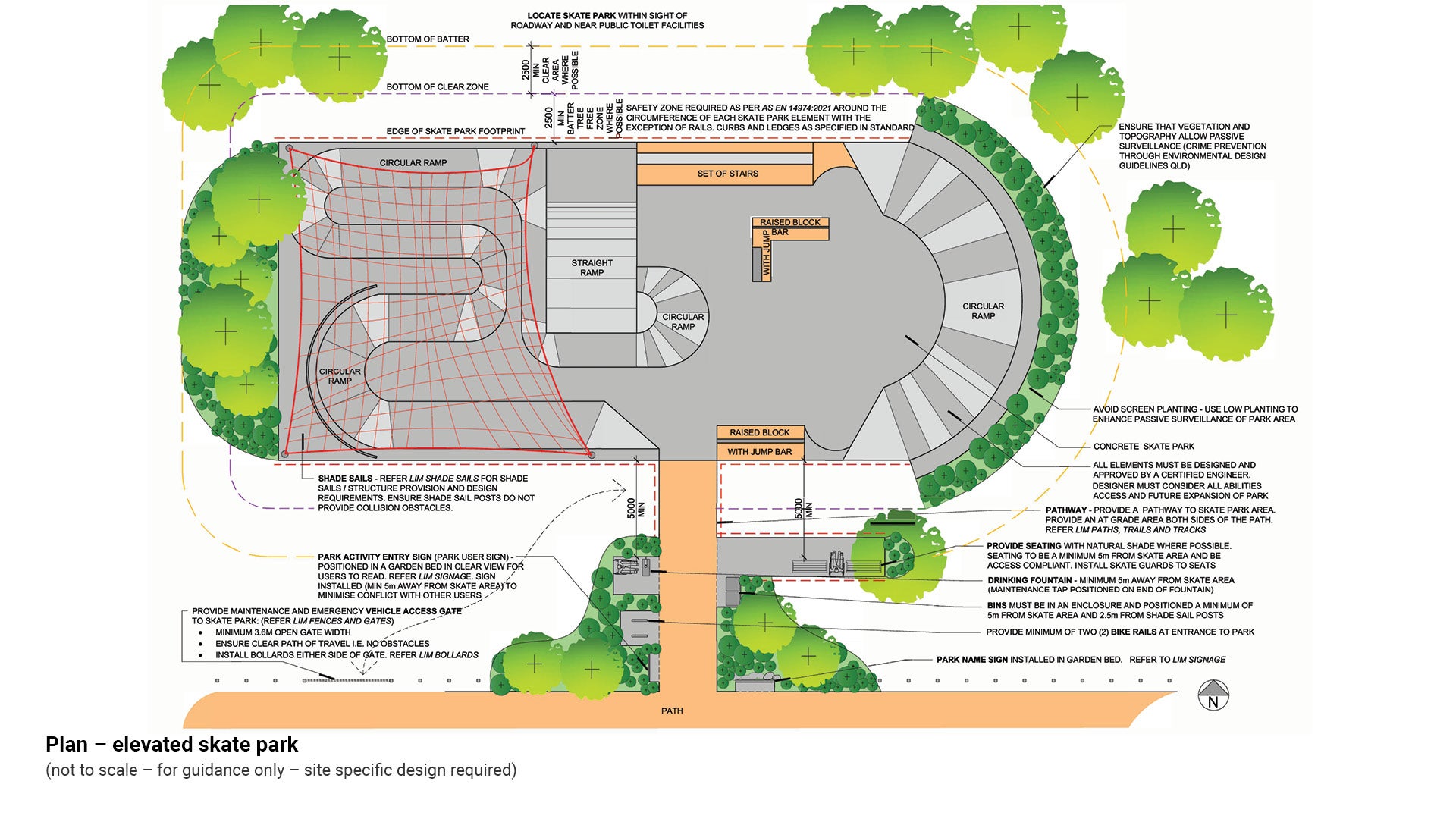
See Figure 1: Plan – elevated skate park for council’s general requirements for design.
Site vehicle access
- Consider access for emergency services vehicles in the design.
- Provide access for maintenance vehicles
See LIM Fences and gates for further guidance.
Figure 1: Plan – elevated skate park
Site setout – skate elements
- Allow ample space for run up and landings at the beginning and end of elements to reduce conflict and enhance safety (particularly important for the installation of shade sail posts).
- At transition areas, consider safety issues and drop off hazards, and provide safe level changes, and batter planting.
Skate park – safety zones
As per AS EN 14974:2021 Skateparks - Safety requirements and test methods:
- Each skate element is to have a safety zone of around it’s circumference, with the exception of rails, curbs/ledges, as specified in the standard.
- Safety zones may intersect one another and must be free of obstacles.
- Safety zones are not intended as a viewing platform for spectators.
- The surface is to be made of bound uniform material (such as concrete), NOT loose material such as sand.
- Plants are permitted in the safety zone if they are arranged in a way that does not pose a risk to users.
- A safety zone is not required in the adjacent area behind a skate element which is provided with a platform or behind a wall.
Clearances
See LIM Shade sails for further guidance.
Table 1: Positioning guidance offsets
Embellishment | Distance from | Minimum distance | Reason |
Skate area | Bins | 5.0 m (see LIM Bins) | Safety offset (runoff area) to minimise conflict with other users. |
Skate area | Taps | 5.0 m | Safety offset (runoff area) to minimise conflict with other users. |
Skate area | Drinking fountain | 5.0 m | Safety offset (runoff area) to minimise conflict with other users. |
Skate area | Bicycle rails | 5.0 m | Safety offset (runoff area) to minimise conflict with other users. |
Skate area | Seating | 5.0 m | Safety offset (runoff area) to minimise conflict with other users. |
Skate area | Activity entry sign | 5.0 m install at entry, garden bed preferred (see LIM Signage). | For regulatory guidance. Safety offset (runoff area) to minimise conflict with other users. |
Skate area | Barbecue | 10 m | Safety offset (runoff area) to minimise conflict with other users. |
Skate area | Outdoor ashtray | 10 m (see LIM Bins) | Tobacco and Other Smoking Products Act 1998 and regulations. Smoking is banned within 10 m of a skate park. Outdoor ashtrays are to be located more than 10 m from a skate park. |
Skate area | Play space, sports ground (our similar) | An appropriate distance | As per AS EN 14974:2021 Skateparks - Safety requirements and test methods, where skateparks are erected or built in combination with playgrounds, sportgrounds (or similar), they shall be separated by an appropriate distance using structural or spatial measures. |
Skate park concrete slab edge | Any other items | 2.5 m | For deck mower clearance (where possible). |
Shade sail post base | Shade sail connection point | 4.5 m high | To prevent unintended access to shade sail. |
Shade sail | Highest skate park point | 3.0 m high | To prevent unintended access to shade sail. |
Shade sail | Tree - any part of a tree that can be used as leverage to climb upon. | 2.5 m (to be determined by tree species). | To provide shade and to prevent unintended access to shade sail. |
Shade sail | Any embellishment that can be climbed on (e.g. wheelie bin enclosure). | 2.5 m (however skate safety offset listed above needs to be observed). | To prevent unintended access to shade sails. |
This component is currently in development